

Introduction: The Floor Your Clients Notice First
Walk into any commercial building and one of the first things you register is the state of the floor. A clean, well-maintained carpet communicates professionalism. In contrast, a worn, stained, or odorous one communicates the opposite. That impression forms within seconds.
For business owners and facilities managers across Yorkshire, carpet maintenance rarely sits at the top of the priority list. As a result, it tends to get addressed reactively. By the time a stain is too obvious to ignore, the damage to the carpet has already been done.
This article sets out the real reasons why regular commercial carpet cleaning is a business necessity, not a nicety. We cover the health case, the compliance angle, the financial logic, and the impact on staff wellbeing. We also explain what your carpets say about your business to the people who matter most.
Whether you manage a single office in Leeds, a group of schools across West Yorkshire, or a hotel in Harrogate, the same principles apply.
What Most Businesses Get Wrong About Carpet Maintenance
Vacuuming Is Not Cleaning
The most common mistake is confusing regular vacuuming with genuine cleaning. Vacuuming is essential. However, it only removes surface debris. Fine grit, oily soils, bacteria, and allergens continue to build up deep within carpet fibres over time, entirely untouched by the vacuum head.
Think of it this way. Every footstep drives particles further into the pile. Shoes carry in fine grit from pavements and car parks. Over months and years, that grit acts like sandpaper against carpet fibres, causing carpets to lose texture, develop matted traffic lanes, and take on a dull grey appearance that no amount of vacuuming will reverse.
Waiting Until Carpets Look Dirty Is Too Late
The second mistake is waiting until carpets look dirty before booking a clean. When soiling becomes visible to a visitor, the carpet has usually been deteriorating for much longer. Soil builds up in layers, and the surface layer is only the most recent addition to a deeper problem. In fact, by the time a carpet looks bad, it has typically been holding bacteria, allergens, and embedded debris for months.
Not All Cleaning Methods Are Equal
The third mistake is treating all carpet cleaning as equivalent. A domestic machine hired from a supermarket operates at a fraction of the temperature and extraction power of a commercial truck-mounted unit. Using the wrong equipment leaves excess moisture in the carpet backing, which creates ideal conditions for mould. Furthermore, it can leave detergent residue that attracts future soiling, meaning the carpet gets dirtier faster than it would have without the clean at all.
Professional commercial carpet cleaning addresses all three problems. It reaches soil that vacuuming cannot touch, restores appearance before deterioration becomes irreversible, and uses the right equipment and chemistry for the specific carpet and environment.
The Health and Hygiene Case
What Builds Up in a Commercial Carpet
Commercial carpets in high-footfall environments accumulate significant biological and chemical matter over time. This is not a dramatic claim. It is simply a consequence of the volume of people and activity passing through a building every day.
The NHS has highlighted the role that indoor environments play in respiratory health and allergen exposure. Carpets act as reservoirs for dust mites, pollen, mould spores, and fine particulate matter. Consequently, in offices or educational environments where people spend hours each day, the effect on individuals with asthma or allergies can be significant.
Bacteria and Biological Contamination
Beyond allergens, commercial carpets can harbour bacteria from spillages that were surface-cleaned but not fully treated. Urine contamination in communal areas, food and drink spillages in breakout rooms, and mud brought in during wet weather all contribute to a biological load that routine cleaning cannot address.
Regular professional cleaning removes this accumulated material from deep within the pile. In particular, in environments with clinical or hygiene obligations, such as dental practices, healthcare facilities, and schools, this level of cleaning is not optional. Maintaining a safe environment for staff, patients, and visitors depends on it.
The Odour Problem
Persistent carpet odour in a commercial environment is almost always a sign of biological contamination at depth, rather than surface soiling. Masking sprays treat the symptom, whereas professional extraction with deodorising agents treats the source. In a reception area, hotel lobby, or school corridor, persistent odour is one of the most damaging impressions a business can make.
The Compliance and Duty of Care Angle
Your Legal Obligations as an Employer
Employers and building operators in the UK carry a legal duty of care towards the people who occupy or visit their premises. Specifically, the Health and Safety at Work Act 1974 requires employers to maintain workplaces in a condition that does not pose a risk to health and safety.
Poorly maintained carpets contribute to slip and trip hazards, particularly in areas where carpet edges have lifted or where wet contamination has not been treated. Beyond trip hazards, heavily soiled carpets in poorly ventilated buildings raise legitimate indoor air quality concerns for employers responsible for their team’s wellbeing.
Regulated Sectors Face Higher Standards
For businesses in regulated sectors, the expectations are higher still. Schools, care homes, healthcare settings, and food preparation environments all face inspection regimes where inspectors consider the condition of the built environment alongside care and operational standards. As a result, a carpet in poor condition is not just an aesthetic concern in these settings. It can directly contribute to an adverse inspection outcome.
Protecting Managing Agents and Facilities Managers
Facilities managers and managing agents who oversee multiple sites have an additional consideration to bear in mind. Service level agreements and lease obligations often include maintenance standards that cover flooring. Therefore, regular professional cleaning creates a documented record that demonstrates compliance and protects the managing party in the event of a dilapidations dispute.
At DynoClean, every commercial clean includes photo documentation at completion and a signed post-inspection walkthrough. Consequently, clients receive a clear record of the work carried out, which is particularly valuable for facilities managers reporting to property owners across multiple sites.
The Financial Case: Cleaning Versus Replacing
Replacement Is Expensive
Commercial carpet replacement represents a significant capital expenditure. A mid-quality carpet tile across an average open-plan office floor, including supply, fitting, and business disruption during installation, is a cost that most finance directors would rather defer for as long as possible.
Regular Cleaning Extends Carpet Life
The single most effective way to extend the life of a commercial carpet is regular professional cleaning. Extraction cleaning removes the abrasive grit that degrades carpet fibres. In addition, hot water extraction reverses traffic lane browning caused by oily atmospheric soils, and professional pre-treatment chemistry can recover carpets that appear beyond saving.
The Institute of Inspection Cleaning and Restoration Certification (IICRC) is the internationally recognised standard-setting body for the cleaning and restoration industry. Their guidance consistently supports the finding that carpets on a regular professional programme last significantly longer than those cleaned only reactively.
The Numbers Make Sense
The financial logic is straightforward. A carpet on a regular cleaning programme typically lasts considerably longer than one cleaned only when it becomes visibly problematic. Moreover, the cumulative cost of a cleaning programme over that extended life is a fraction of the cost of early replacement.
For businesses operating on tight margins, this is therefore not a peripheral consideration. It is a direct, measurable contribution to managing capital expenditure and protecting assets.
Staff Wellbeing and Productivity
The Physical Environment Matters to Your Team
There is a growing body of evidence linking the quality of the physical work environment to employee wellbeing and productivity. The condition of flooring may seem like a minor variable. However, the cumulative effect of working in a clean, well-maintained environment versus a tired, poorly maintained one is real and measurable.
Staff notice the condition of their workplace. A business that maintains clean, fresh-smelling carpets communicates to employees that it values their environment. In competitive employment markets, furthermore, the quality of the physical workspace influences how people feel about their employer and whether they want to remain there.
Fewer Sick Days and Fewer Symptoms
Clean carpets have a measurable effect on respiratory health in the workplace. Employees with hay fever, asthma, or dust allergies experience fewer symptoms in environments with lower allergen loads. As a result, fewer sick days, fewer concentration-disrupting symptoms, and fewer complaints about air quality are all potential outcomes of a consistent carpet maintenance programme.
Hospitality Businesses: The Review Score Connection
For hotel and hospitality businesses, the connection is even more direct. Guests notice odours, stained corridors, and tired flooring immediately, and they share those observations on review platforms. Consequently, a room that smells fresh and a corridor that looks well-maintained contribute directly to the review scores that drive future bookings.
First Impressions and Brand Reputation
What a Visitor Sees Before You Speak
Every business has a reception area or client-facing space where the condition of the building makes an immediate impression. In many cases, that impression forms before a single word is exchanged.
A visibly soiled or stained carpet tells a visitor something specific about the business. It suggests a lack of attention to detail and a tolerance for deterioration. Whether those inferences are fair is beside the point, because they form quickly and influence how the visitor feels about the business before any commercial conversation begins.
Professional Services and Office Environments
For professional services firms, law practices, accountancy firms, and recruitment businesses, the physical environment acts as a proxy for the quality of the work. A well-maintained office communicates that standards matter. By contrast, a tired, stained one communicates the opposite, and that signal is difficult to undo once a client has formed it.
Retail: Customers Who Linger Buy More
For retail environments, the issue is particularly immediate. Customers decide whether to enter, browse, and buy based partly on how a store looks and smells. Clean, fresh flooring creates a welcoming atmosphere, whereas heavily soiled carpet creates a subconscious reluctance to linger. Ultimately, customers who do not linger do not buy.
Hotels: Flooring Drives Review Scores
For hotels and hospitality venues, bedroom carpet and corridor flooring are among the most scrutinised elements of a guest’s stay. Review platforms contain numerous comments about flooring condition, and those comments influence the decisions of future guests. This is therefore a direct, trackable impact on revenue from a maintenance variable entirely within the operator’s control.
How Often Should a Business Have Its Carpets Professionally Cleaned?
There is no universal answer to this question, because the right cleaning frequency depends on site-specific variables. However, there are general principles that apply across most commercial environments.
High-Footfall Environments
Hotels, schools, retail, and healthcare settings benefit most from a combination of approaches. Low-moisture encapsulation maintenance every two to three months keeps carpets presentable day to day. In addition, a deeper truck-mounted extraction clean once or twice a year tackles the embedded soiling that builds up over time.
Medium-Footfall Environments
Offices, co-working spaces, and professional services firms typically need a professional extraction clean once or twice a year, supported by regular in-house vacuuming. However, reception areas and meeting rooms receive more concentrated traffic than open-plan areas and may therefore benefit from more frequent attention.
Lower-Footfall Environments
Storage areas, secondary corridors, and back-of-house spaces usually only need an annual professional clean. Nevertheless, specific incidents such as water ingress or spillages should always be addressed promptly rather than deferred to a scheduled programme.
Ultimately, the best way to determine the right programme for your building is a free site survey. An experienced commercial carpet cleaner will assess fibre type, traffic patterns, soiling levels, and operational constraints before making a specific recommendation.
Choosing the Right Method for Your Building
Not all commercial carpet cleaning methods are the same. The right method depends on carpet construction, soiling levels, operational constraints, and drying time requirements.
Truck-Mounted Hot Water Extraction
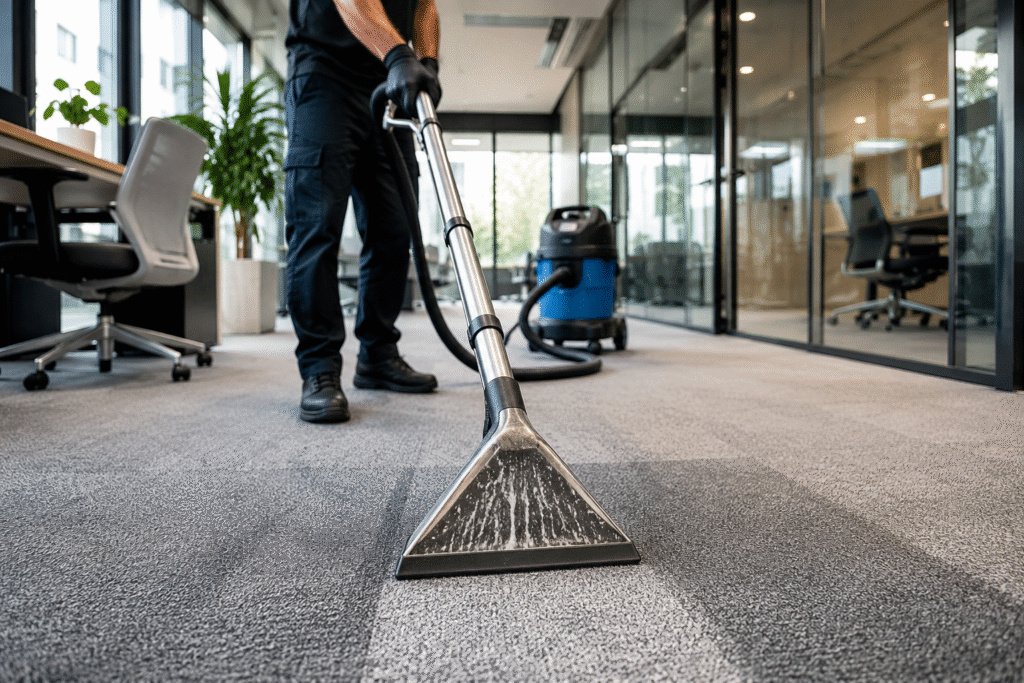
Truck-mounted extraction is the most thorough method for deeply soiled or contaminated carpets. The truck-mounted unit generates far higher water temperature and extraction pressure than portable machines, meaning it penetrates deep into the carpet pile, lifts embedded soils from the backing, and recovers the vast majority of moisture during the cleaning process.
This method is the right choice for end-of-tenancy deep cleans, carpets not professionally cleaned for an extended period, and environments with biological contamination such as urine or food spillage. In short, it suits any situation where thorough restoration is required rather than a surface refresh.
Typical drying time is 2 to 6 hours. To speed this up, air movers accelerate drying and return areas to use as quickly as possible.
Low-Moisture Encapsulation
Encapsulation uses polymer chemistry to surround soil particles and bind them into dry crystals, which are then vacuumed out during routine cleaning. Because the process uses minimal moisture, drying times are typically 30 to 90 minutes, making it well-suited for occupied buildings during trading hours.
Encapsulation works well for interim maintenance cleans between extraction programmes and in high-footfall areas that cannot be taken out of service for extended periods. Although it is not a substitute for periodic extraction cleaning, as part of a blended programme it keeps carpets consistently presentable between deeper cleans.
Blended Programmes
Most commercial buildings benefit from a combination of both methods. For example, a typical programme for a medium-to-large site involves truck-mounted extraction once or twice a year, with quarterly encapsulation maintenance in high-footfall reception, corridor, and breakout areas. The specific balance is determined at the site survey and agreed with the client before any work begins.
What to Expect from a Professional Commercial Carpet Clean
A professional commercial carpet clean is a structured, multi-stage process. Every stage serves a specific purpose, and cutting any of them reduces the quality and longevity of the result.
The 9 Stages of a DynoClean Commercial Clean
1. Survey and testing: Before any cleaning begins, the technician identifies fibre type, checks dye stability, inspects seams, and plans access. This step prevents damage and ensures the right method and chemistry are applied to each area.
2. Industrial pre-vacuum: Removing the dry soil load before wet cleaning begins protects fibres and improves extraction efficiency. Additionally, it prevents dry soils from turning to mud during the cleaning process.
3. Targeted pre-treatments: Known stains, traffic lanes, spillage areas, and biological contamination receive specific treatment before the primary clean. This is precisely what separates a clean that removes stains from one that only lightens them.
4. Agitation: Mechanical agitation suspends soil evenly across the pile, so the primary cleaning method can then extract it uniformly rather than leaving concentrated pockets of soiling.
5. Primary clean: Hot water extraction or encapsulation, as specified, is carried out across the entire area according to the agreed programme.
6. Neutralise and deodorise: A residue-free neutralising rinse ensures no detergent remains in the carpet. Furthermore, deodorising treatment is applied where required, with optional antimicrobial treatment available for clinical or hygiene-critical environments.
7. Speed-drying: Air movers accelerate evaporation and return the area to use quickly. This is particularly important in commercial environments where extended downtime has operational implications.
8. Groom and protect: An optional stain-repellent application creates a protective barrier on carpet fibres, repels liquid spills, and makes day-to-day maintenance more effective. Carpet grooming also restores pile direction for a consistent, professional finish.
9. Post-inspection and sign-off: A walkthrough with the site contact confirms the work meets the agreed standard. Finally, we provide photographic documentation and aftercare guidance to help you maintain results between professional cleans.
What Makes DynoClean Different for Yorkshire Businesses
Over 25 Years of Commercial Experience
DynoClean has provided commercial floor and carpet cleaning services for over 25 years. Based in Knaresborough, North Yorkshire, our team works with offices, schools, hotels, retail environments, healthcare settings, gyms, and facilities managers managing multi-site portfolios across Yorkshire and the wider UK.
Commercial-Grade Equipment
Our fleet includes truck-mounted extraction units, HEPA-filtered dust control, and diamond encapsulation systems. These are not domestic or semi-professional machines. Instead, they are the same commercial-grade equipment used by national contract cleaning companies, delivered with the attention to detail of a specialist independent contractor.
No Disruption to Your Operation
Nights, early mornings, and weekends are available as standard, so your operation is never disrupted. Our low-moisture encapsulation method suits occupied buildings during trading hours, and all schedules are agreed around your operational calendar, not ours.
Documented, Audited Results
Every clean includes test patches before work starts and photographic documentation at completion. As a result, you always have a clear record of the condition of your carpets before and after our visit. This is standard practice on every job, not an optional extra.
One Point of Contact
There are no call centres, no account management layers, and no handoffs. You deal directly with the people doing the work, which means clear communication, accurate scoping, and consistent delivery on every visit.
To find out more about our specialist services across the region, visit our commercial carpet cleaning Yorkshire page.
Summary: The Business Case in Brief
Regular professional commercial carpet cleaning is a practical necessity with measurable returns. To summarise the key points covered in this article:
- Vacuuming removes surface debris, but it does not address embedded soils, allergens, bacteria, and abrasive particles deeper in the pile.
- Those embedded contaminants degrade carpet fibres, shorten carpet life, and create hygiene risks in clinical or food safety environments.
- Regular professional cleaning removes contamination, restores appearance, and extends carpet life, thereby deferring the cost of replacement.
- The health and compliance implications are real and legally relevant for employers across many sectors.
- Carpet condition makes a direct, immediate impression on clients, customers, guests, and staff, and it influences commercial outcomes from conversion rates to hotel review scores.
- The right cleaning method depends on the specific environment, and a professional site survey is therefore the starting point for any well-managed programme.
If you manage commercial premises across Yorkshire and want to discuss a cleaning programme, contact DynoClean today. Same-week survey slots are available, and all surveys are free with no obligation.
Call us on 07971 606 721 or visit our contact page to arrange your free site survey.
About the author: This article was written by the DynoClean team. DynoClean is a specialist commercial carpet and floor cleaning company based in Knaresborough, North Yorkshire. With over 25 years of experience, we serve offices, schools, hotels, healthcare settings, and facilities managers across Yorkshire and the UK. All recommendations in this article are based on hands-on operational experience and current industry best practice.
